
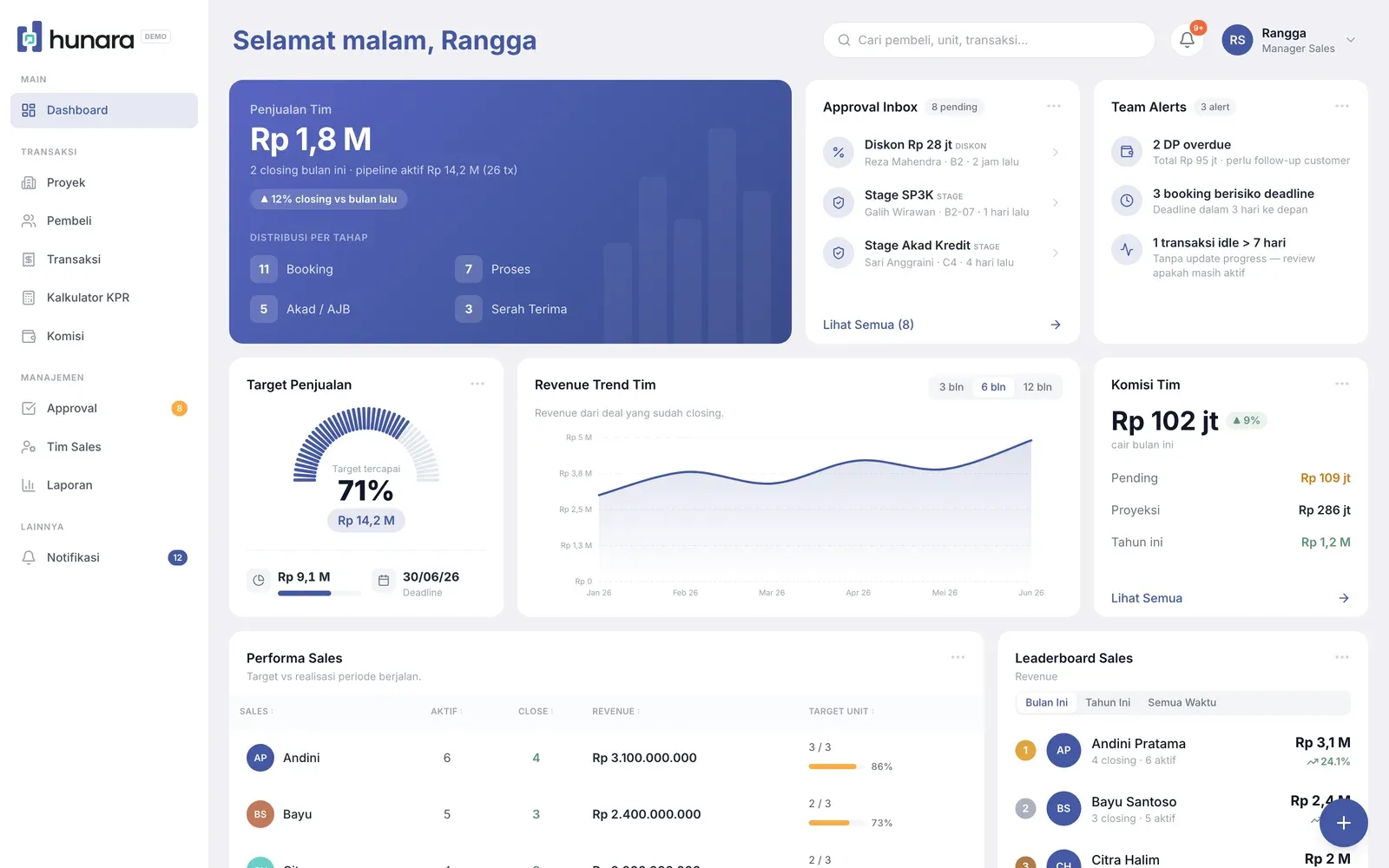
Hunara
Multi-project property sales platform — interactive site plans, a staged pipeline with approvals, KPR calculators, and automated commissions.
Monitor productivity, attendance and work activity in one workspace — then take control of the machine when something breaks. Built for modern remote and hybrid teams that need visibility without complicated workflows.
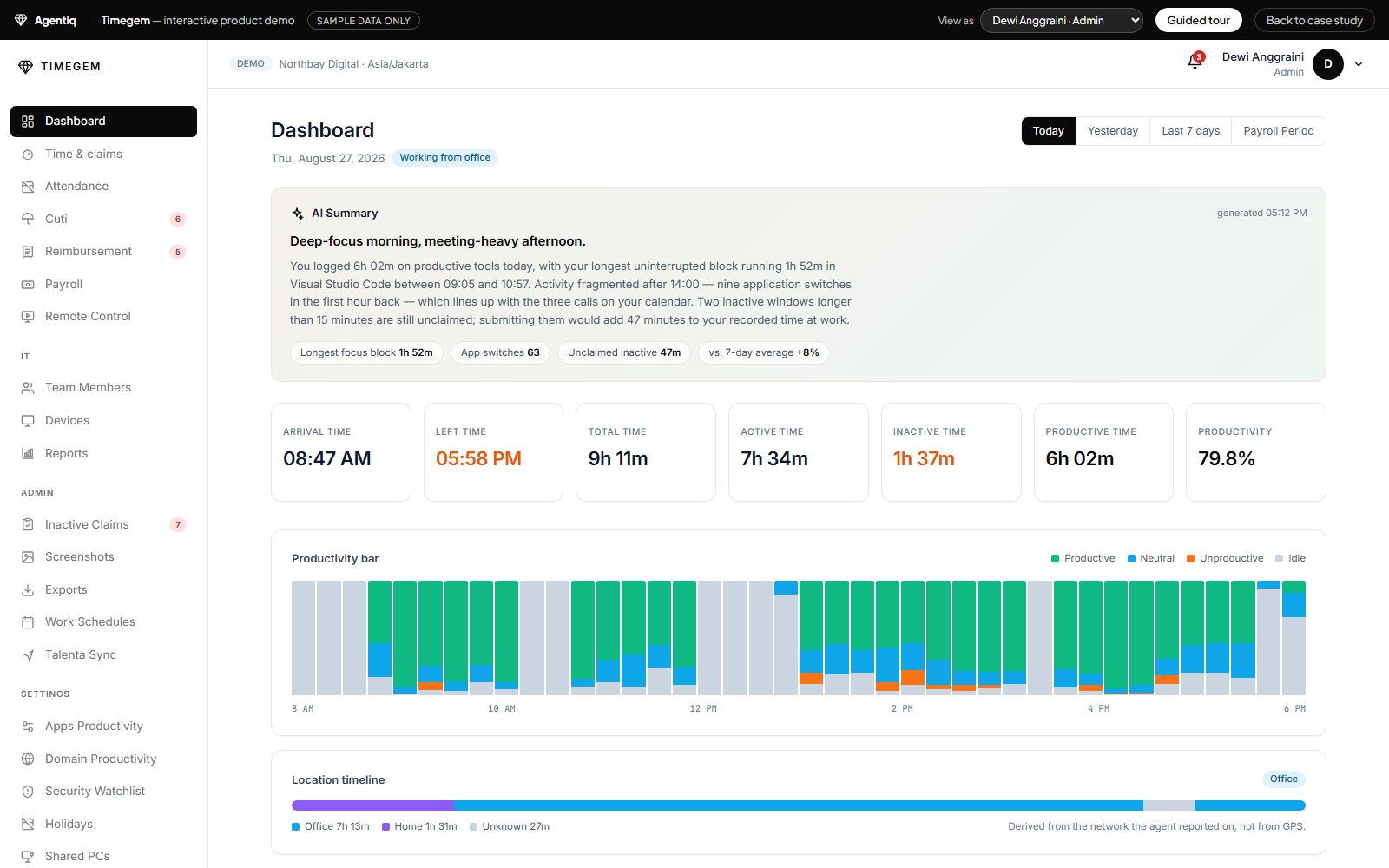
Timegem shows companies how teams actually work through the day — attendance, active hours, productivity trends and application usage — in one clean, readable dashboard. There is no keylogging, no webcam and no input capture anywhere in the product: it records which application had focus and whether the machine was idle, and nothing about what was typed into it.
We built it for a 62-person agency group running a distributed Windows, macOS and Linux fleet across several offices. They were paying per seat for a tracker that could not see offline work, could not tell an office day from a work-from-home day, and could not help IT when a machine went down — everything else lived in spreadsheets. Leave, reimbursement and payroll followed, which retired the HR subscription too. Because Timegem is self-hosted, every screenshot and every activity record stays on infrastructure the client controls.
Case study — built by Agentiq for an anonymised client. The client name, employee names, hostnames and every figure shown are fictional sample data; the product, its feature set and its architecture are real.
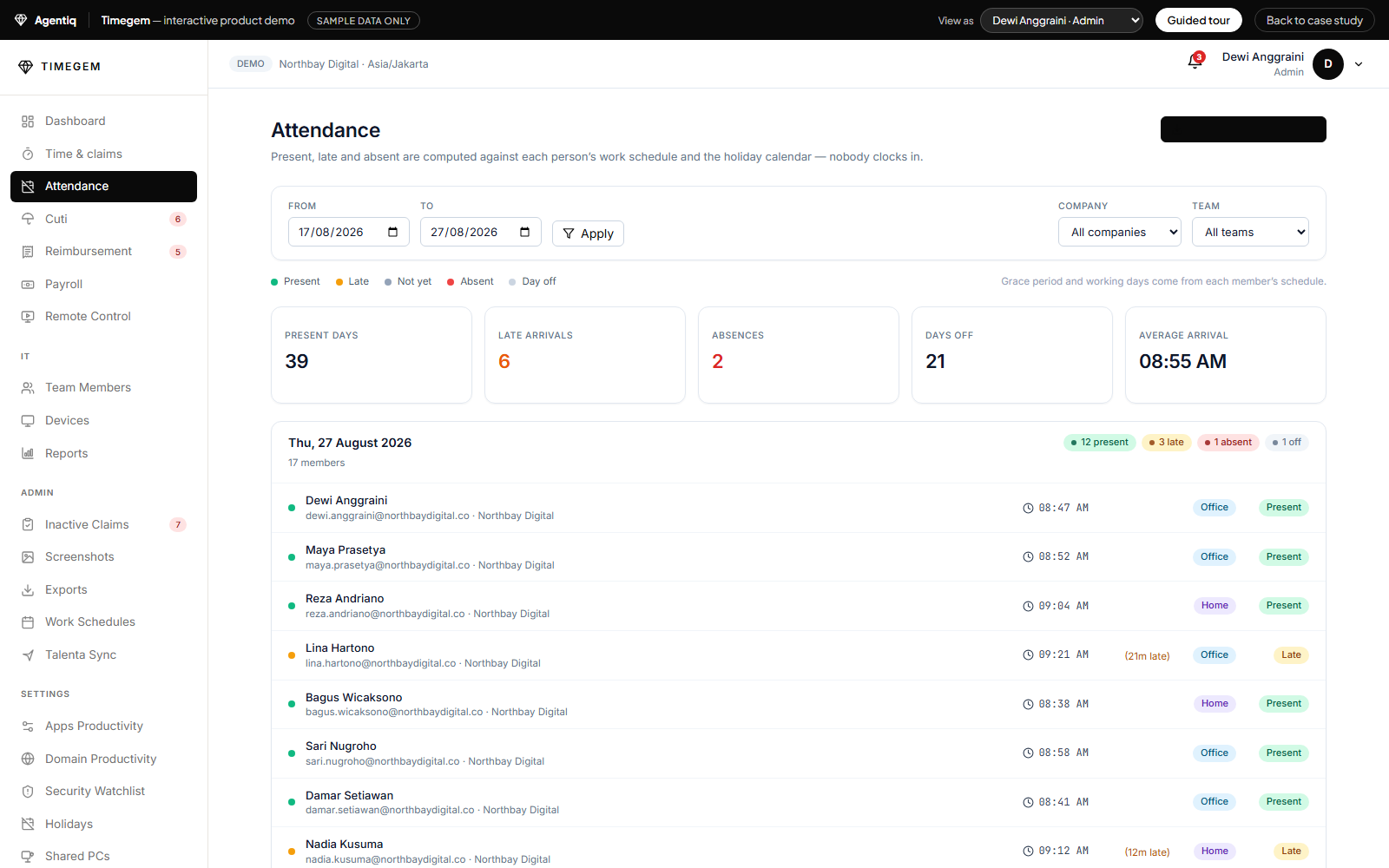
Clock-in, clock-out and attendance status are derived from desktop activity — nobody punches a card. Timegem also tells office, work-from-home and VPN sessions apart on its own, from the network the agent reported on.
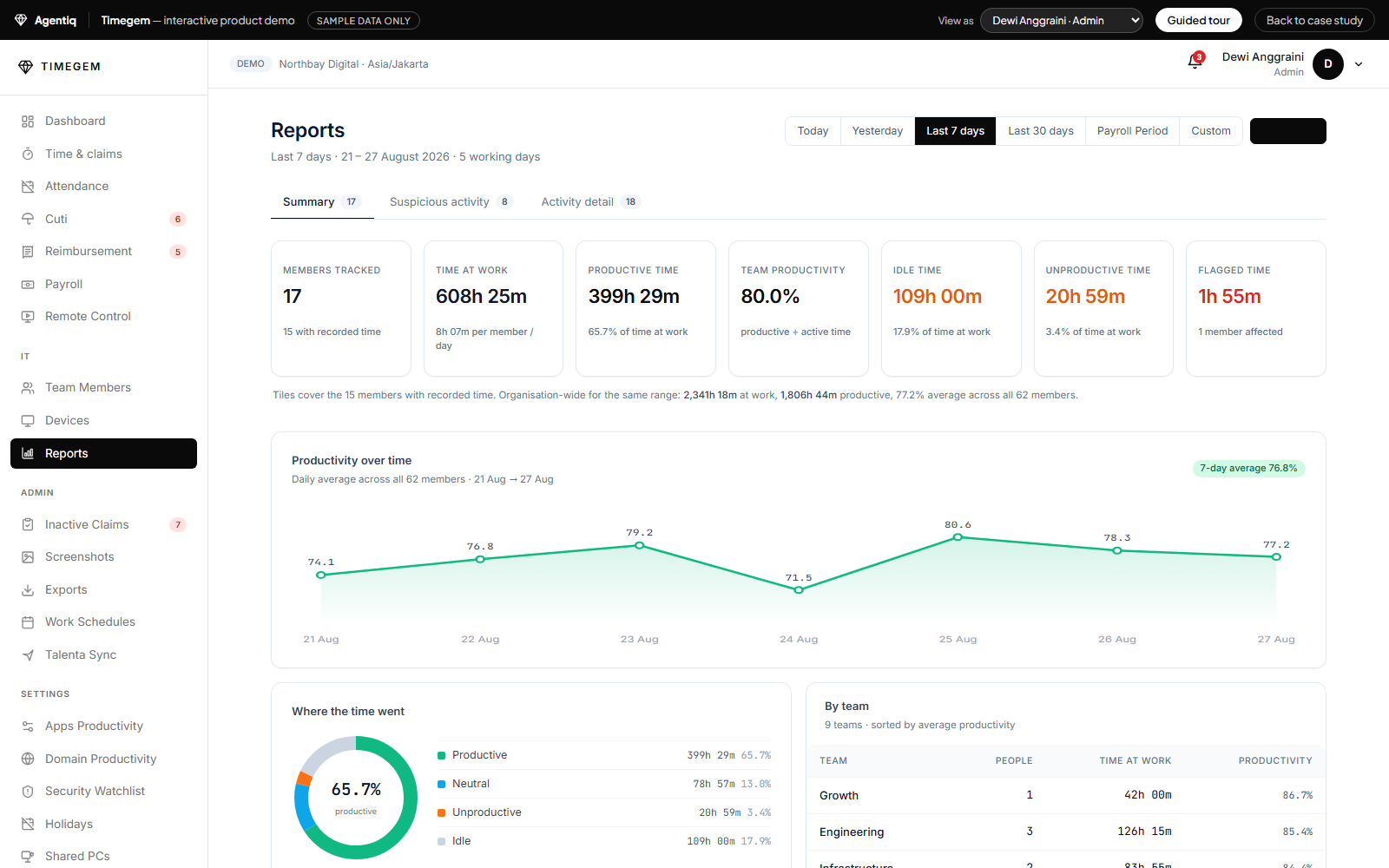
Productive, neutral, unproductive and security-flagged time, split live. The categories are yours to define per application and per domain — a rulebook you control, not a vendor's black box.
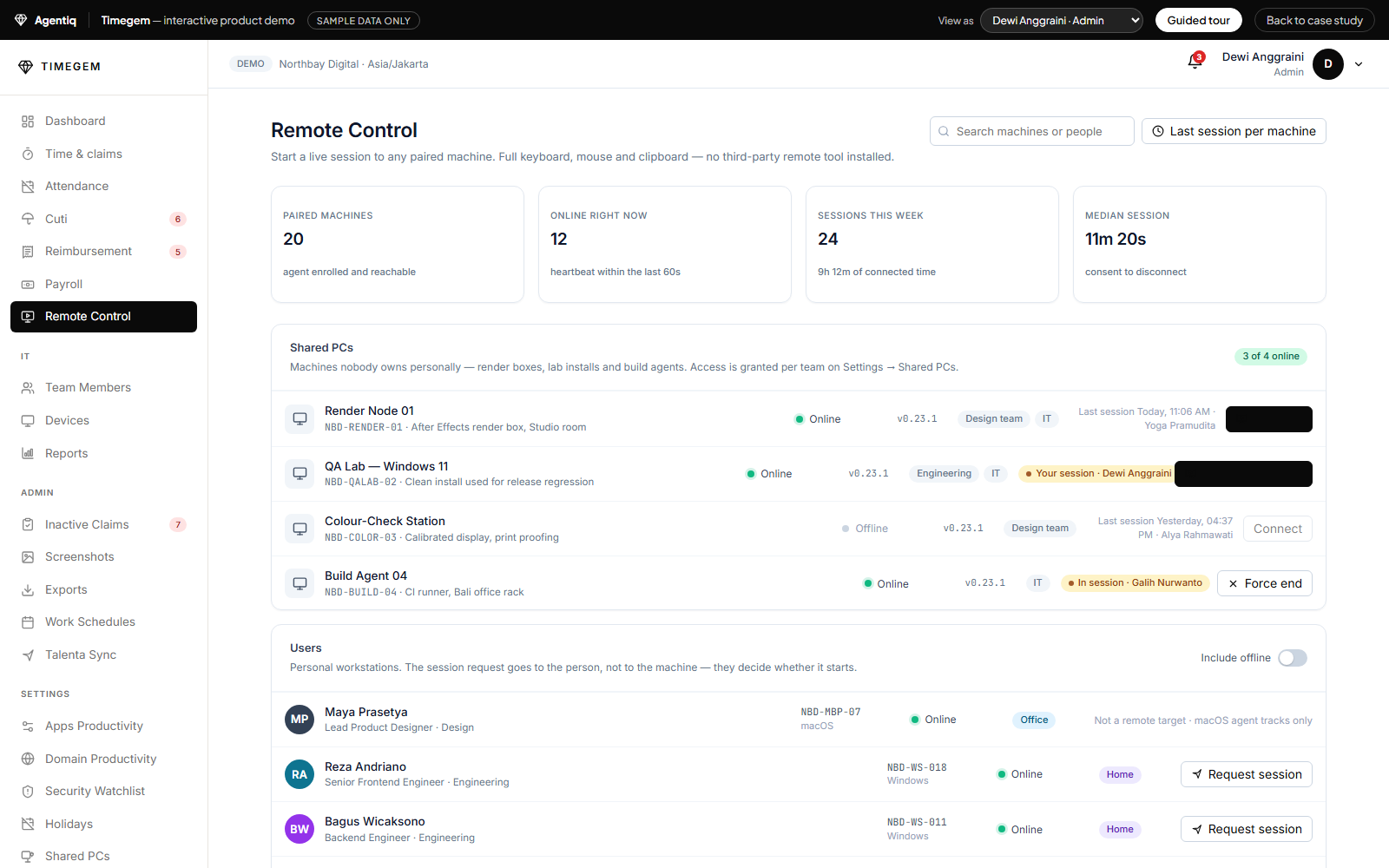
IT opens a live session to any paired Windows machine and drives it with full keyboard, mouse and clipboard, at up to 30 fps with a selectable quality preset. Shared PCs let a whole team operate lab and render machines with one-time enrolment and per-team permissions.
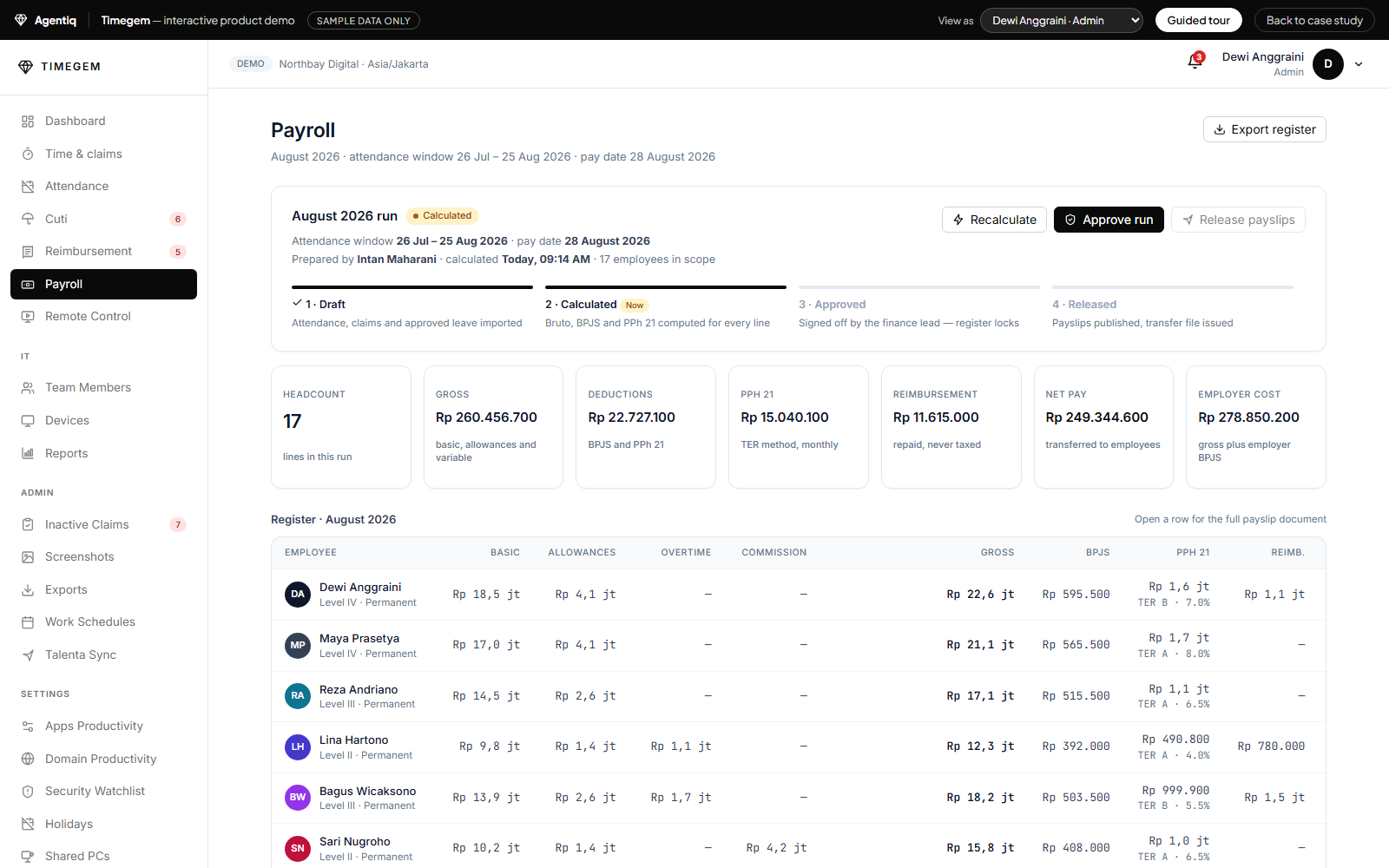
Leave with a real two-level approval line, reimbursement settled through payroll rather than a separate transfer, and a monthly payroll run with BPJS and PPh 21 — the three modules that let the client cancel their HR subscription outright.
01
One command centre per person and per team. Arrival, departure, total, active and idle time, productivity rate and application usage roll up into KPIs — with date ranges that match how the business actually runs, including a payroll period that spans month boundaries. A per-minute activity timeline sits underneath, and managers can view any report exactly as the employee sees it.
02
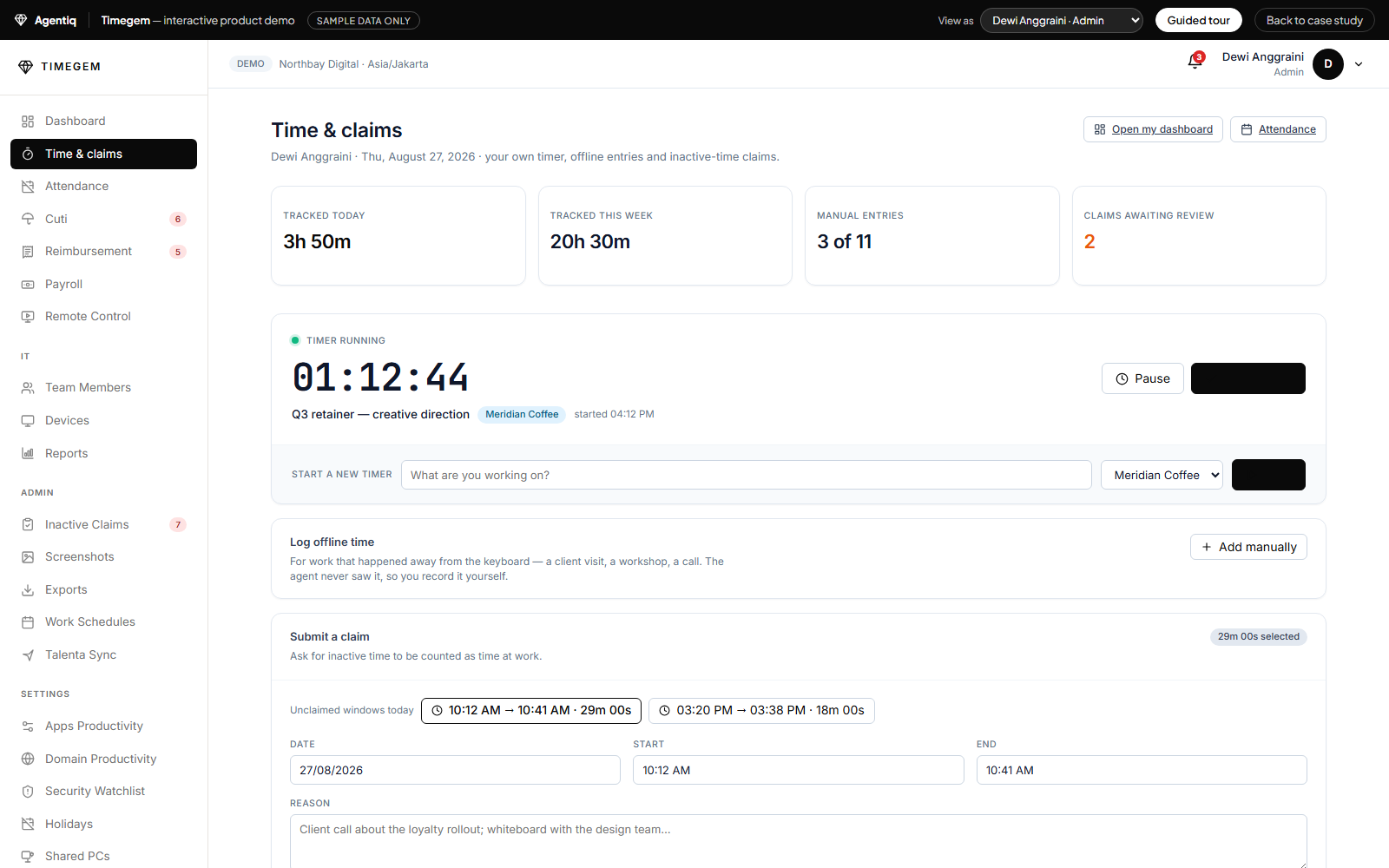
The biggest complaint about activity trackers is that they punish work done away from the keyboard. Timegem turns every idle gap into something claimable: the employee explains it, the manager decides, and the decision is recorded against the approver. Claims are validated against overlaps and a minimum duration, and approved time extends recorded hours in every downstream report.
03
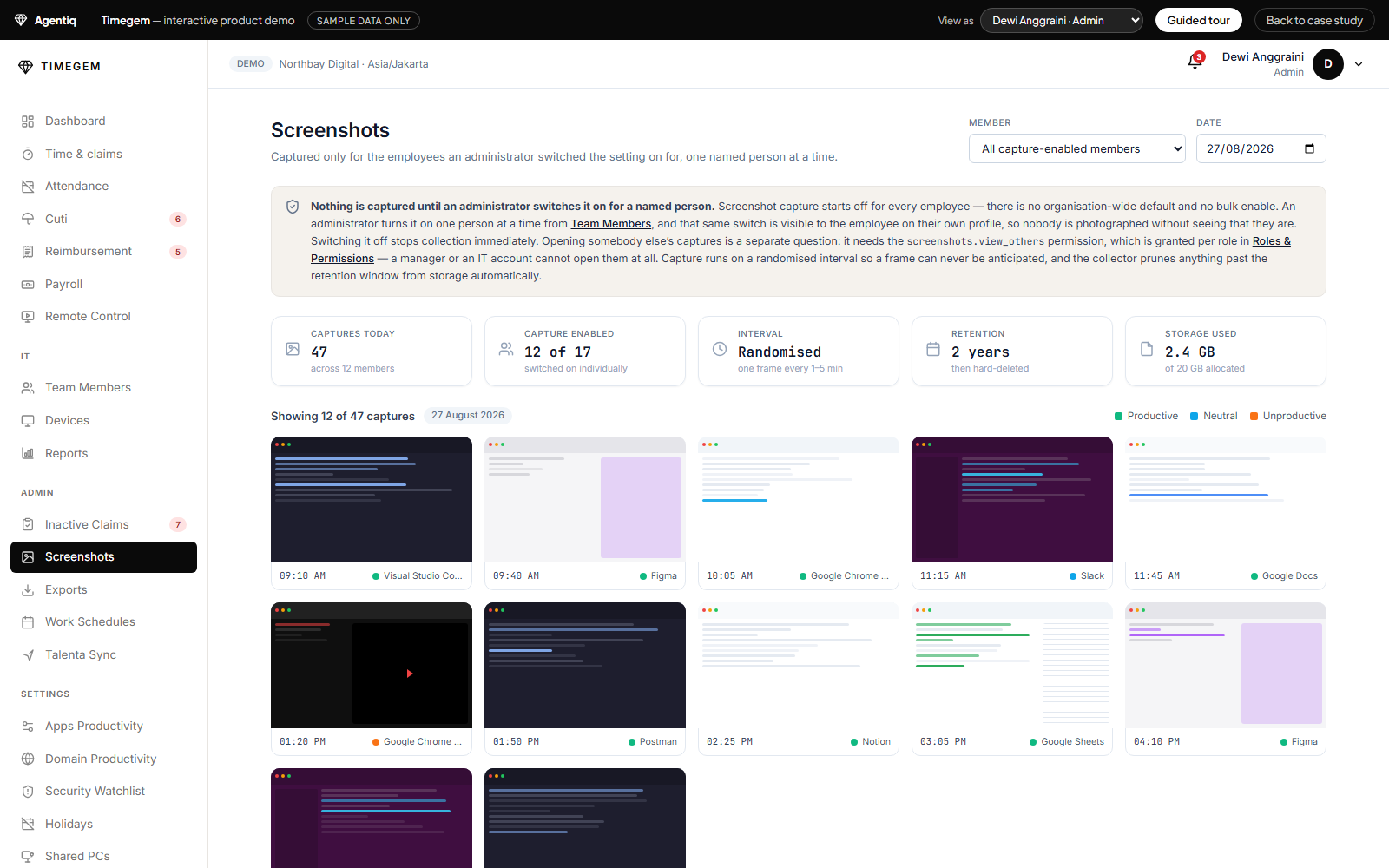
Screenshot capture is off for everyone until an administrator turns it on for a named individual — never organisation-wide by default — and the employee can see the switch on their own profile. Who may open a capture is gated on its own permission in the roles grid. Captures are taken on a randomised interval so they cannot be anticipated, are pruned automatically once they pass the retention window, and live in the client's own object storage.
04
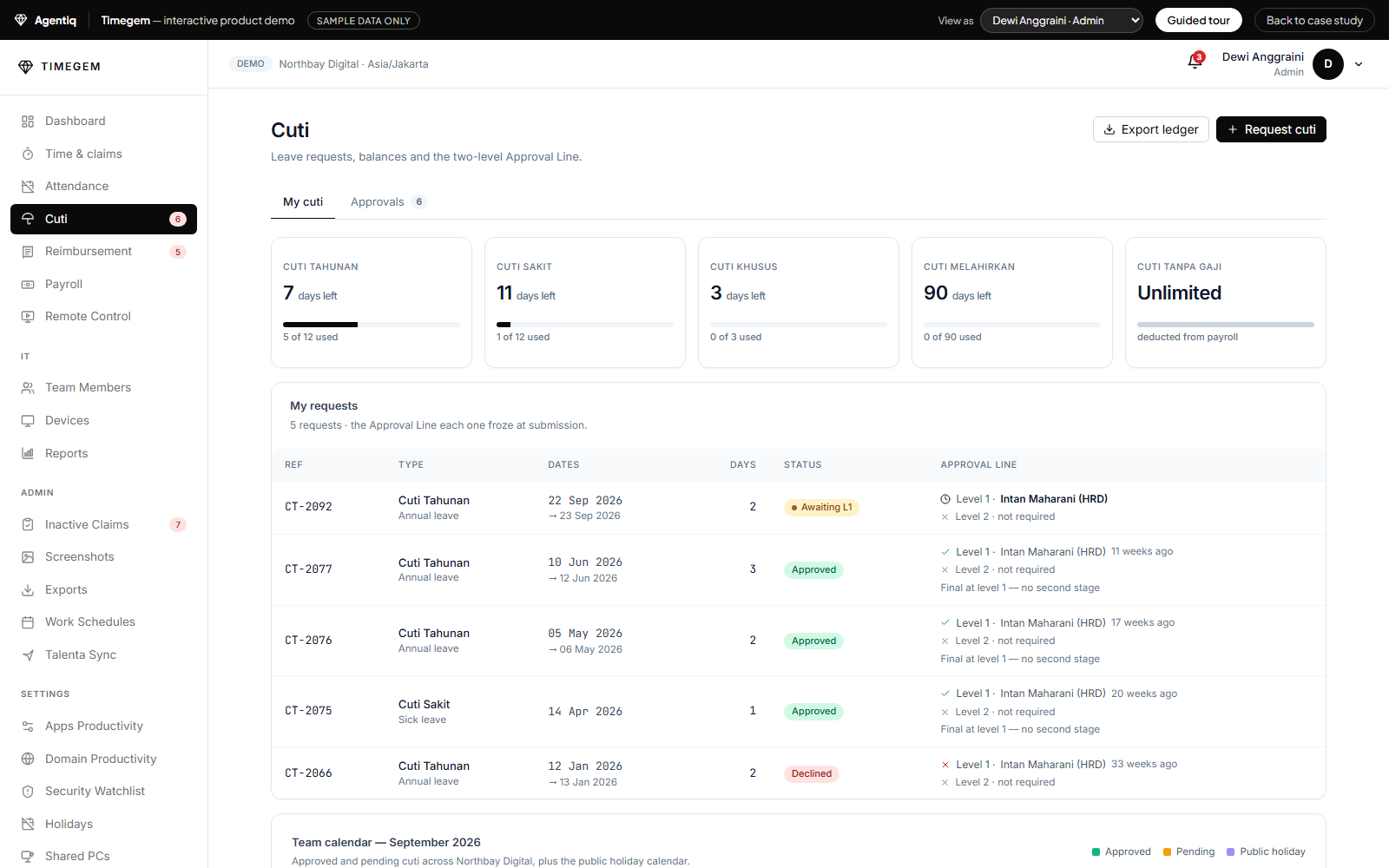
Every employee has a named approval line: level one is their own manager, level two derives from whoever holds the HRD position. The route freezes the moment a request is submitted, so re-organising the company can never re-route a request already in flight — and whoever signs level one is barred from also signing level two. Separation of duties is enforced in the API, not just the interface.
05
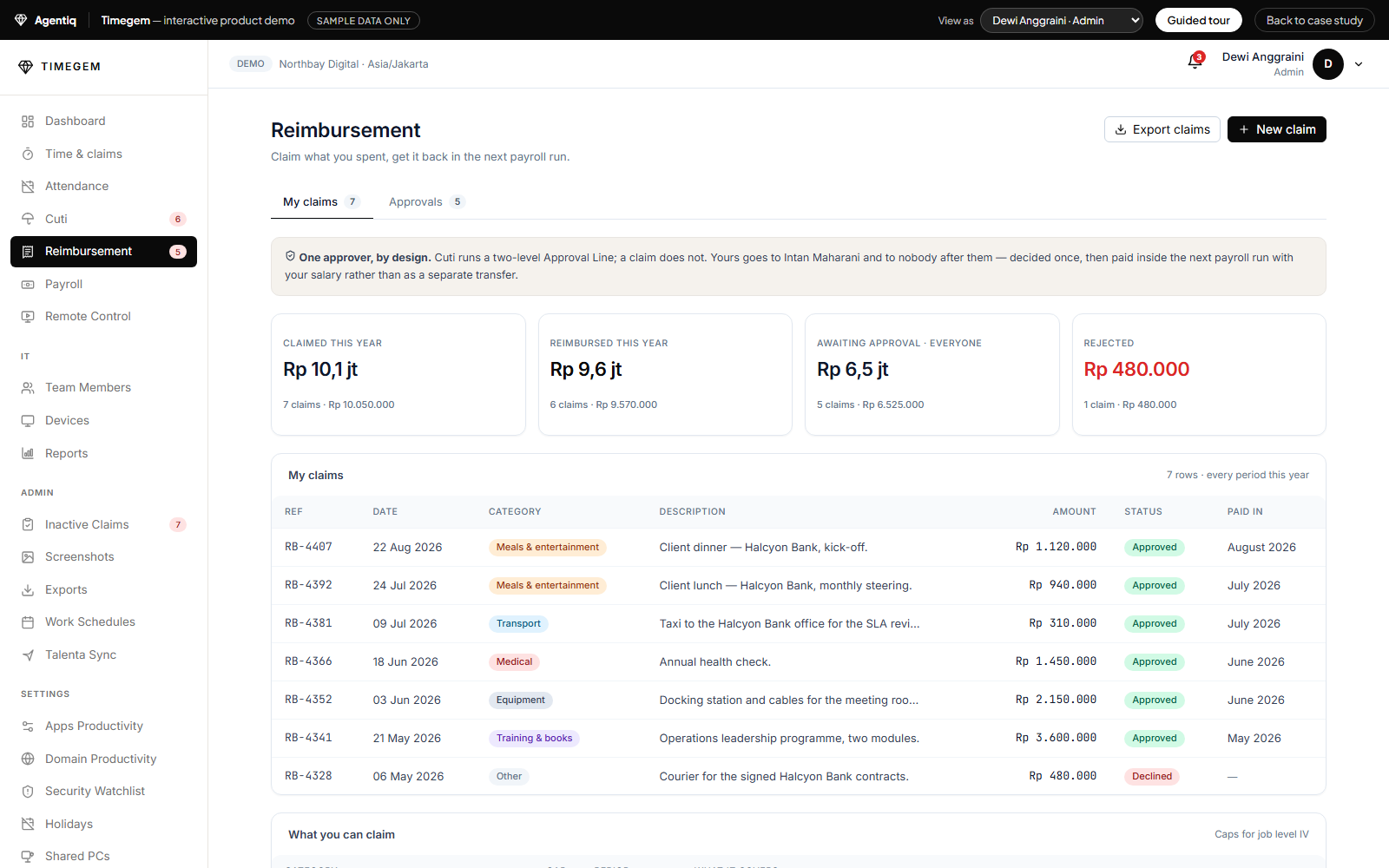
Deliberately simpler than leave: one claim, one approver, one decision. Categories carry caps drawn from the employee's job level, receipts attach to the claim, and an approved claim is picked up by the next payroll run and paid alongside salary instead of as a separate transfer — which is why it appears as its own column on the register, outside the taxable total.
06
The module that made the subscription redundant. A monthly run assembles every component — basic, allowances, overtime, commission, approved reimbursement, unpaid-leave deductions — applies BPJS Kesehatan and Ketenagakerjaan at their own separate caps, computes PPh 21 on the average-effective-rate method, and produces a payslip per employee. Every payslip reconciles: gross minus deductions plus reimbursement equals net.
Multi-project property sales platform — interactive site plans, a staged pipeline with approvals, KPR calculators, and automated commissions.
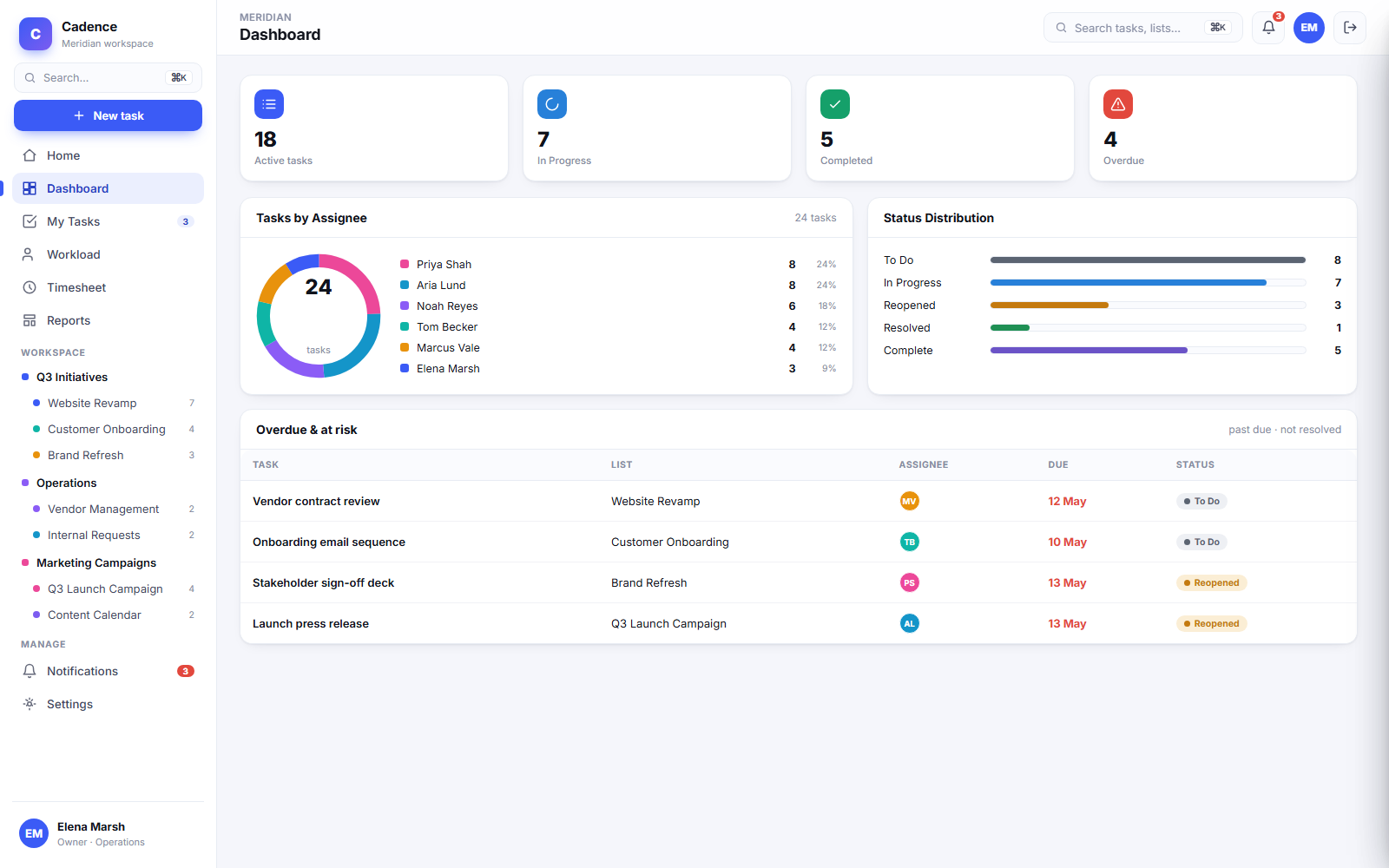
Plan in List, Board and Gantt, track time and team workload, and report in real time — one custom work-management workspace.
Tell us what you need, and we will help turn it into a real application.
